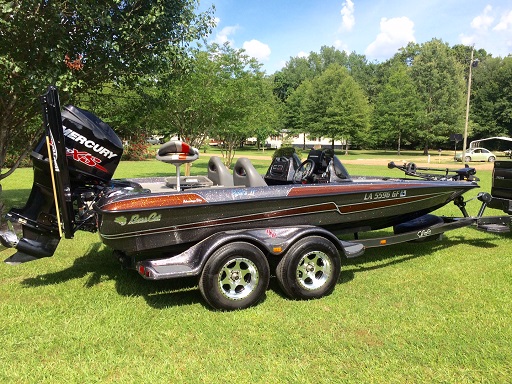
There has been a lot of speculation on the *New Jaguar and the *New Mercury 450R engine. Before the read on the 450R begins we want to be clear that from the start we have said this boat is best with the 300 engines, and better with the 350 and 400 Verado platform. Those engines will do a fine job and on the Jaguar we would absolutely go with as much digital shifting and Power Steering as one can assemble, of course the Mercury DTS series are of a very short supply right now.
The Jaguar is setup to fish and has all four batteries in 31 AGM style. New the boat was able to hold 67 gallons of fuel in the tanks from dry, in new condition. The rig is complete with a Bob’s hydraulic plate and Ultrex. Taking a 2400 to 2500 pound hull (dry weight) close to 100 MPH with the monster 450 HP torque pushing it leaves little room for error. This boat also has Power Steering and the feel is negligible, which becomes a balancing act as five blades fight one direction rotation and remove torque. The 5.44” gearcase also doesn’t run with the same bite as the older Sportmaster cases that were smaller diameter, on the 2.5 block High Performance engines. The standard Mercury Torquemaster Case is also a 4.88” diameter.
Last Wednesday we took it to Lake Ouachita and did a little video work for a future project. There in reasonably short bursts it clicked 90 MPH with two people, light tackle and half fuel. It’s on fire to 80 and crawl quick to 85. Anything after 85 is driver based and it takes full attention to get beyond 85. We were in and out quick, launching out of Echo Marina, and never rounded the bend toward Brady Mountain. Most know that’s a short sprint for this rig.
Friday (8/8/2019) a Mercury Application Engineer (LS) and I spent most of the day on Bull Shoals gathering hard data on the angles, GPS, RPM, fuel burn, and much more. The goal was to gather digital data, gathered through multiple sensors placed on the engine and boat. It records feeds of digital data when triggered and the data is run through a program that builds some phenomenal graphs for technicians to evaluate. Everything most any one can imagine is tracked and able to be analyzed.
We started in the Bull Shoals Dam area before getting run off by afternoon joy riders. When your making runs over 90 MPH, and wanting to test a dozen props, that errant wake board boat or a Walleye rig with five people joy riding can be a challenge. After culling several props and seeing the houseboat, vacationers and retiree pontoon boat parade rotating the area, we loaded up and switched for a run to Oakland
At the Oakland area we were able to make the run to the back of Coon Creek (Music Creek right fork), and the water was really good when we started with an occasional light gust of wind. Boats like this don’t just run max MPH in short bursts like an Eyra with a 250 engine. At Oakland we were able to run the remainder of our propeller selection till about 4:30 PM, when the weekenders started rolling some. We ran a large variety including two (2) variations of the CNC Clever over hub 5 blade in 31” with two degrees of rake. We ran Pro Max’s, Bravo’s, Max Five’s, and a few more. We managed to burn through about 60 gallons of fuel that day just on short runs.
The Max Five’s and CNC Clever’s are the suggested propellers for this surfacing gearcase application. One of the 15.25” x 31” CNC Clevers, in a lower degree of rake, was able to perform solid into the 90’s. The Max Fives will run 90’s also, though all of these have their challenges in handling. With the final prop we were able to give a good test we managed the boat hitting above mid 90’s when it ran out of good water. It slowly just keeps climbing and every boat wake makes keeping it true hard. With recreational boats and pontoons throwing wakes running slow the day came to a close.
We threw in the towel when one last run would have notched triple digits (trips’) and it wasn’t worth the risk. There are very few people with enough experience to twist this beyond 85 MPH and do it with some degree of safety.
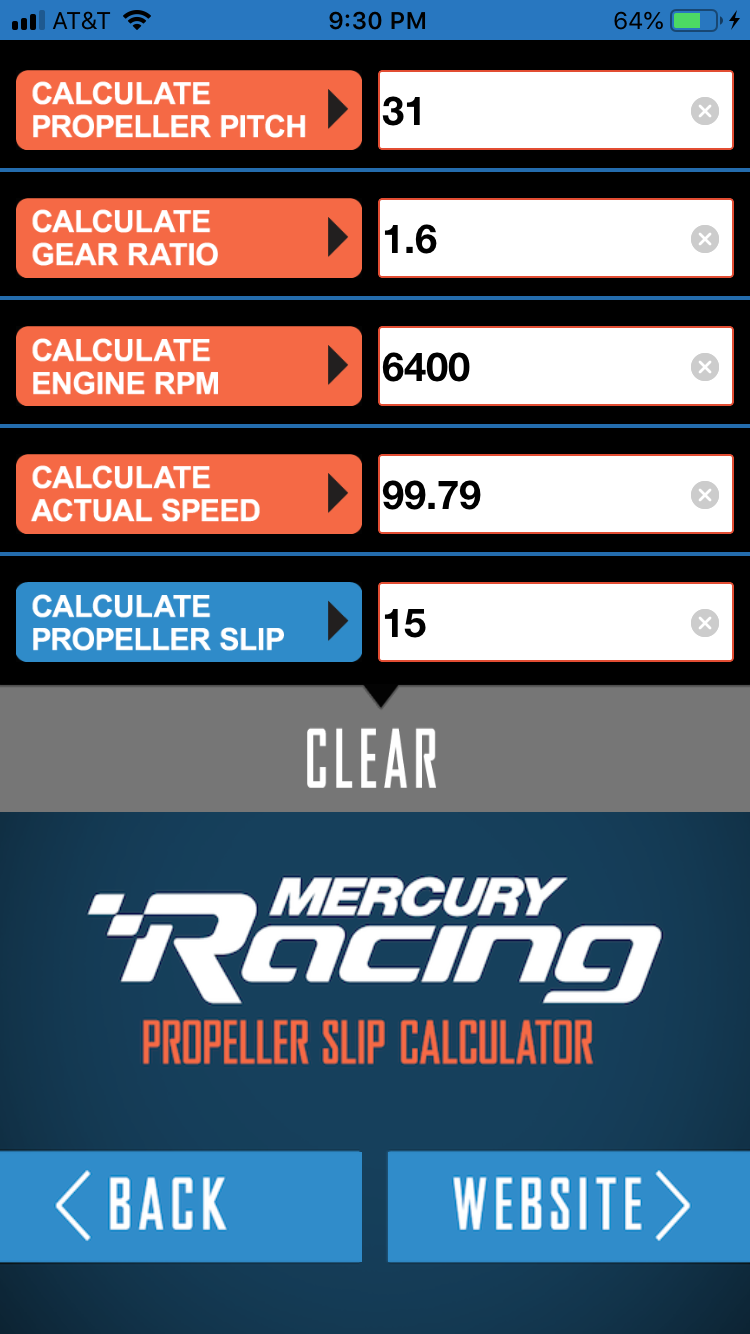
Everyones been anxious on this one and wants to know. It will run trips’ when we manage to get the power to the water and be able to hold it long enough to get there. It takes yards to build momentum and reduce slippage. Calculations on slippage we saw with some of these wheels was around 15% and that’s high. We will manage to click the numbers we expect, though it’s going to be a few days till we get a chance to dial it in more.
Rick Pierce
pitch x .92 (slippage 8%) x RPM / gear ratio (1.75 on 250) / 63,360 (inches in a mile) x 60 (seconds in a minute) = MPH or Calculated Performance possible. The gear ratio on the 450R is a 1.60 ratio. Back that one in reverse and you can estimate slippage.

 .
.